Barn Insulation in Hoover, AL
Plan Your Barn Insulation with a Free On-Site Assessment
Many barns and outbuildings in Hoover feel sweltering by midday in summer and drafty or damp when temperatures drop. If that sounds familiar, you’re not alone. At iFOAM Insulation of Montgomery Metro, we help property owners turn hard-to-use barns into comfortable, more efficient spaces with thoughtful insulation solutions.
We work with a range of insulation materials, including spray foam, BATT, and blown-in options, along with air sealing and retrofit services. Our team focuses on safety, quality, and clear communication so you know what to expect from the first visit through final inspection.
Contact us today or call (334) 276-8541 to schedule a free on-site assessment for your Hoover barn.
Why Insulate Your Hoover Barn
Barns around Hoover face tough conditions. Hot, humid summers heat up metal roofs and walls, while mild winters still bring chilly, damp days that make uninsulated spaces uncomfortable. Without proper insulation, heat can move readily through your barn, while moisture may contribute to stuffy lofts, condensation on metal surfaces, and cold floors.
Good insulation helps slow that heat flow and, when combined with air sealing, can create a more stable environment inside your barn. If your barn is connected to your home system or has its own heating or cooling, insulation can reduce how hard that equipment runs. Insulation may also make workshops and hobby spaces feel quieter and more pleasant.
We also see barn owners in Hoover who simply want to protect what they store. Insulation can help limit extreme temperature swings around stored items. For small livestock or hobby animals, a better insulated barn can support a more consistent shelter environment, especially when paired with appropriate ventilation and care.
How Our Team Insulates Barns
We start with a free on-site assessment where we listen to how you use the barn, where it feels most uncomfortable, and what your goals are. Our team then looks at the building itself, including framing, existing materials, obvious air leaks, and any visible moisture concerns.
After that visit, we talk through insulation options that fit your barn and budget. Because we install spray foam insulation, BATT, and blown-in products, along with air sealing and retrofit work, we can suggest a combination rather than a single material. We explain where insulation would be added, what R-values make sense for your assembly, and how each option may perform in your barn.
When you’re ready to move forward, we schedule the installation at a time that works for you. Our installers, who are trained in the iFOAM way, arrive with the equipment and materials needed for your project. We review the plan on site, walk through any preparation steps, and coordinate protection or moving of animals, equipment, or stored items as needed.
During installation, we follow stringent safety protocols and keep the work area as organized as possible. For spray foam insulation projects, we plan around application conditions, curing times, and ventilation and explain re-entry timing for specific areas based on the project details. If old insulation needs to be removed as part of a retrofit, we handle that work carefully to manage dust and debris.
Once insulation is in place, we inspect the completed work, address any remaining gaps or details, and clean up the jobsite. Before we leave, we walk the space with you, answer questions, and review what was done.
Barn Insulation Options We Offer
Different barns need different insulation approaches. A metal building used as a workshop won’t have the same needs as a wood-framed barn that houses animals or hay. Because we install several types of insulation and provide air sealing and retrofit services, we can match materials to the way your barn is built and used.
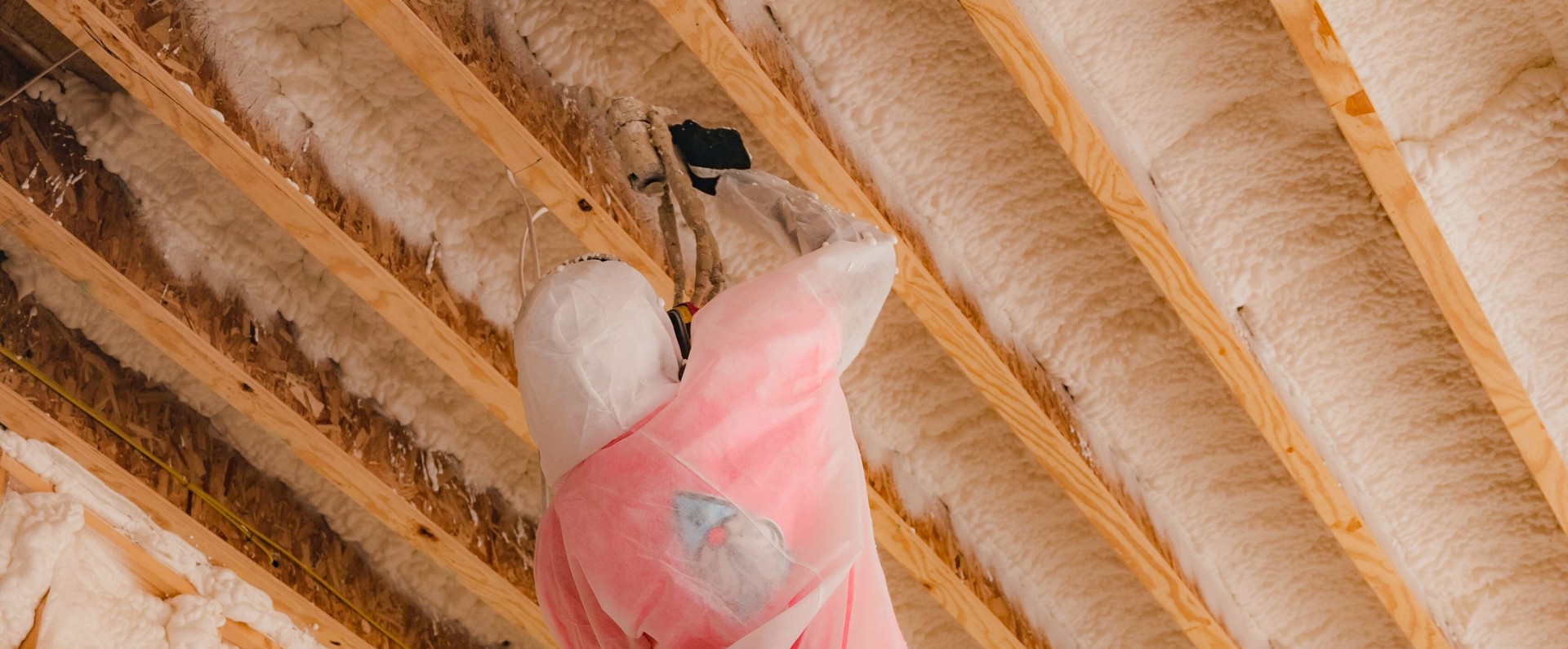
Spray foam insulation is a popular choice for many barns, especially metal structures and pole barns. It adheres directly to surfaces, fills cracks, and creates an air seal that helps control drafts. Closed-cell spray foam insulation can also add rigidity and act as a moisture barrier, which may be helpful under metal roofs where condensation can form when warm, moist air meets cooler surfaces.
BATT insulation can work well in framed wall cavities or loft floors when the structure is accessible and kept relatively dry. For some barns, we may suggest combining BATT with air sealing along sill plates, around doors, and at penetrations to improve overall performance. Blow-in cellulose or a blown-in blanket can be a good fit for certain ceiling or loft applications where we need to cover irregular areas more evenly.
We also look at how insulation interacts with ventilation in your barn. Proper ventilation is important, particularly around animals or stored materials that release moisture. During our assessment, we discuss how insulation and air movement can work together to improve comfort while reducing the risk of trapped moisture.
Our recommendations are tailored to your specific building. Instead of pushing one product, we explain the advantages and limitations of each option and help you weigh initial cost against long-term performance and use. That way, the insulation you choose supports how you actually live and work on your property.
Why Barn Owners Choose iFOAM Insulation of Montgomery Metro
When you invite a crew to work on your barn, you want people who understand both building performance and real-world use. At iFOAM Insulation of Montgomery Metro, we bring our insulation experience to barns, shops, and outbuildings throughout the Hoover area. Our team starts with careful assessments and clear recommendations, so you understand what can be installed and why.
Quality and safety guide each part of our work. Our installers are trained in the iFOAM way, which means they follow consistent steps for preparation, installation, and final checks. We use industry-leading techniques and materials and integrate safety protocols from the moment we arrive on your property until cleanup is finished.
For many barn owners, it is also helpful that we can address other areas of the property with services such as concrete leveling and crawl space encapsulation. If you’re working on a larger improvement plan, you can coordinate these related services through one team.
Barn Insulation Planning by Use: Livestock, Equipment & Workshops
How you use your building shapes which insulation approach makes the most sense. At iFOAM Insulation of Montgomery Metro, we base our recommendations on your barn’s specific structure, its contents, and how you work in it day to day. Whether you’re insulating a small barn or a large commercial agricultural building, the planning process starts with understanding what the space actually needs to do.
Livestock Areas
Livestock areas have different insulation and ventilation considerations from dry storage or work areas. We address those differences during the assessment.
Equipment and Vehicle Storage
Tractors, classic cars, boats, and other stored equipment can benefit from limiting temperature swings, reducing drafts, and managing condensation around metal surfaces. The priority here tends to be stability rather than a fully conditioned environment, and we select materials and locations accordingly.
Workshops and Hobby Spaces
A barn used as a workshop or hobby area requires attention to comfort, air leakage, and the portions of the space that will be heated or cooled. We help identify which areas benefit most from insulation and where air sealing at penetrations, doors, and framing connections can reduce drafts and improve the effectiveness of any heating or cooling equipment.
Larger Agricultural Buildings
A large commercial agricultural building used for multiple purposes may call for an insulation plan divided by use zones rather than treated as a single uniform space. A dry storage wing and an occupied work area, for example, may call for different materials or approaches. We work through those differences during the free assessment so that your final plan reflects how each part of the building is actually used.
Frequently Asked Questions
Will Barn Insulation Help with Summer Heat in Hoover?
Insulation can reduce heat gain in barns, especially under metal roofs. By slowing heat flow and sealing air leaks, your space may feel cooler and less stuffy. Results vary based on building design, ventilation, and existing conditions.
Can You Insulate My Barn Without Moving Everything Out?
In many cases, we can work around larger items and protect what stays in place. We typically ask that small or delicate items be moved or covered before work begins. During our assessment, we discuss what needs to be cleared and plan the project to limit disruption as much as possible.
How Long Does a Typical Barn Insulation Project Take?
Most barn insulation projects take from part of a day to a few days, depending on size, access, and whether old insulation must be removed. When we provide your quote, we also outline an expected timeline.
Will Spray Foam Insulation Be Safe Around My Animals?
Animals should stay away from work areas during spray foam insulation application and initial curing. Re-entry timing depends on the materials, application conditions, ventilation, and project details. Our team explains how long to keep animals out and what to expect at each stage.
Plan Your Hoover Barn Insulation Project
We tailor recommendations to your barn’s structure, contents, and intended use, then carry the work from preparation through final inspection. To discuss your project, reach out, schedule a visit, or call (334) 276-8541.
Contact us now at (334) 276-8541 to schedule your free barn insulation consultation.
-
STEPSchedule a Free AssessmentDuring your free in-home assessment, we’ll evaluate insulation levels and provide honest recommendations for improvement. We’ll leave you with a free estimate to know just what to expect, and we’ll answer all your questions.
-
STEPLet Our Team InstallThanks to our simple and easy installation process, your new insulation system will be installed before you know it! They’ll make sure to get the work done efficiently, accurately, and with minimal disruption to your daily routine.
-
STEPEnsure QualityWith the help of advanced testing techniques and proprietary technology, our team can accurately measure and diagnose insulation performance in any home, ensuring your new installation is working at its best and you’re free of other issues.
-
STEPCleanupBefore we leave, we’ll make sure to clean up any mess created during the installation process. We take pride in leaving our customers’ homes as clean as we found them.
-
STEPFinal InspectionTo finish off our service, we’ll conduct a final inspection to ensure your satisfaction with the installation process and the results. We want to make sure you’re getting the most out of your investment and feeling comfortable in your newly insulated space.


-
How Do I Know If My Home Needs New Insulation?
Here are several signs that your home may need new insulation:
- Frozen Pipes
- Uneaven Temperatures Throughout Your Home
- Cold Floors
- High Energy Bills
- Drafts Around Windows and Doors
- Ice dams
Finally, consider the age of your insulation:
- Batt/Fiberglass. Fiberglass insulation should last roughly 7-10 years.
- Cellulose. Blown-in cellulose should last roughly 10-15 years.
- Spray Foam. Spray foam should last 80-100 years, or the age of the house (as long as it was installed properly).
Our experts can provide an accurate assessment of the state of your home’s insulation. We'll consider your energy efficiency with state-of-the-art technology and years of industry know-how.
Give us a call to book your free consultation!
-
Why Use Spray Foam?
Spray foam has been rated to have the highest efficiency and R-value when compared to other insulation (like batt fiberglass).
Furthermore, spray foam's intuitive design allows it to create an airtight seal even in tricky and problematic spaces. It has been proven to keep out air pollutants and help soundproof buildings.
Visit our blog to learn about spray foam's benefits and why its a great choice for your home.
-
How Much Will My Installation Cost?
Prices vary from project to project. For an accurate assessment tailor-made to your home's needs, give our team a call today! You can also discover additional insights on why spray foam is worth the cost by visiting our blog.



Explore Our Family Of Brands