

Spray Foam vs. Fiberglass vs. Cellulose: What’s Best for Your Home?
When it comes to improving comfort and lowering energy bills, choosing the right insulation matters. Homeowners throughout Charlotte, Huntersville, Cornelius, Mooresville, Denver, Gastonia, Concord, and surrounding communities often ask:
"Should I choose spray foam, fiberglass, or cellulose insulation?"
Each insulation type has advantages, but the best choice depends on your goals, budget, and the areas of your home that need improvement.
This guide compares spray foam, fiberglass, and cellulose insulation to help you make an informed decision.
Why Insulation Matters
Proper home insulation helps:
- Lower heating and cooling costs
- Improve indoor comfort
- Reduce HVAC strain
- Improve indoor air quality
- Increase energy efficiency
Effective thermal insulation reduces heat transfer, helping your home stay cooler in summer and warmer in winter.
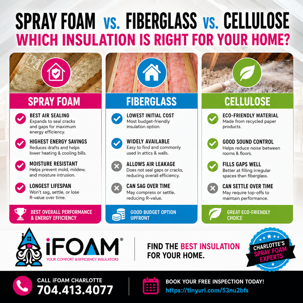
Spray Foam Insulation
Spray foam insulation is considered one of the most effective insulation solutions available.
Advantages
✔ Superior air sealing
Spray foam expands to fill cracks, gaps, and penetrations that traditional insulation leaves behind.
✔ Higher energy efficiency
Because spray foam both insulates and air seals, it creates a stronger building envelope.
✔ Moisture resistance
Closed-cell spray foam helps prevent moisture intrusion and condensation.
✔ Long lifespan
Unlike some traditional insulation products, spray foam does not sag or settle over time.
Best Applications
- Attic foam insulation
- Crawl space encapsulation
- Basement spray foam insulation
- Insulation for the walls
- Metal buildings
Considerations
Spray foam insulation cost is typically higher upfront, but many homeowners recover the investment through lower utility bills and improved comfort.
Fiberglass Insulation
Fiberglass remains one of the most common insulation products used in residential construction.
Advantages
✔ Lower initial cost
✔ Readily available
✔ Commonly used in attics and walls
Limitations
- Does not air seal
- Can compress or sag
- Performance decreases if exposed to moisture
- Allows air leakage
Fiberglass can provide adequate insulation but often performs below its rated value when air movement is present.
Cellulose Insulation
Cellulose insulation is made from recycled paper materials treated for fire resistance.
Advantages
✔ Eco-friendly
✔ Good attic coverage
✔ Helps reduce sound transmission
Limitations
- Can settle over time
- May absorb moisture
- May require future top-offs
Cellulose is commonly used as a blown-in attic insulation solution.
Which Insulation Is Best?
Choose Spray Foam If:
- You want maximum energy efficiency
- You want air sealing and insulation together
- You want long-term performance
- You are encapsulating an attic or crawl space
Choose Fiberglass If:
- Budget is the primary concern
- You need basic insulation performance
- You are insulating large areas at lower cost
Choose Cellulose If:
- You prefer recycled materials
- You want a cost-effective attic upgrade
- You want better coverage than fiberglass batts
What About Existing Insulation?
If insulation is damaged, wet, moldy, or contaminated, professional insulation removal may be necessary before installing new materials.
Why Homeowners Choose iFOAM Charlotte
iFOAM Charlotte specializes in energy efficient insulation solutions throughout the Greater Charlotte area.
✔ Spray foam experts
✔ Crawl space encapsulation specialists
✔ Attic insulation professionals
✔ Honest recommendations
✔ Local experience
📞 704.413.4077
🌐 https://www.ifoam.com/~/northwest-charlotte-nc/
Frequently Asked Questions
Is spray foam insulation worth the extra cost?
For many homeowners, yes. Spray foam provides insulation and air sealing in one application, helping reduce energy bills and improve comfort.
What is the best insulation for attic spaces?
Spray foam and blown-in cellulose are among the best insulation options for attics depending on performance goals and budget.
Is cellulose better than fiberglass?
Cellulose typically fills gaps more effectively than fiberglass and often provides better overall attic coverage.
Can insulation lower my energy bills?
Yes. Proper insulation and air sealing can significantly reduce heating and cooling costs.
How do I know if I need new insulation?
Signs include high utility bills, uneven temperatures, drafts, excessive dust, and HVAC systems that run constantly.